Formulation Architecture
Serum Formulation Architecture: Why the Order of Ingredients Is Part of the Effect
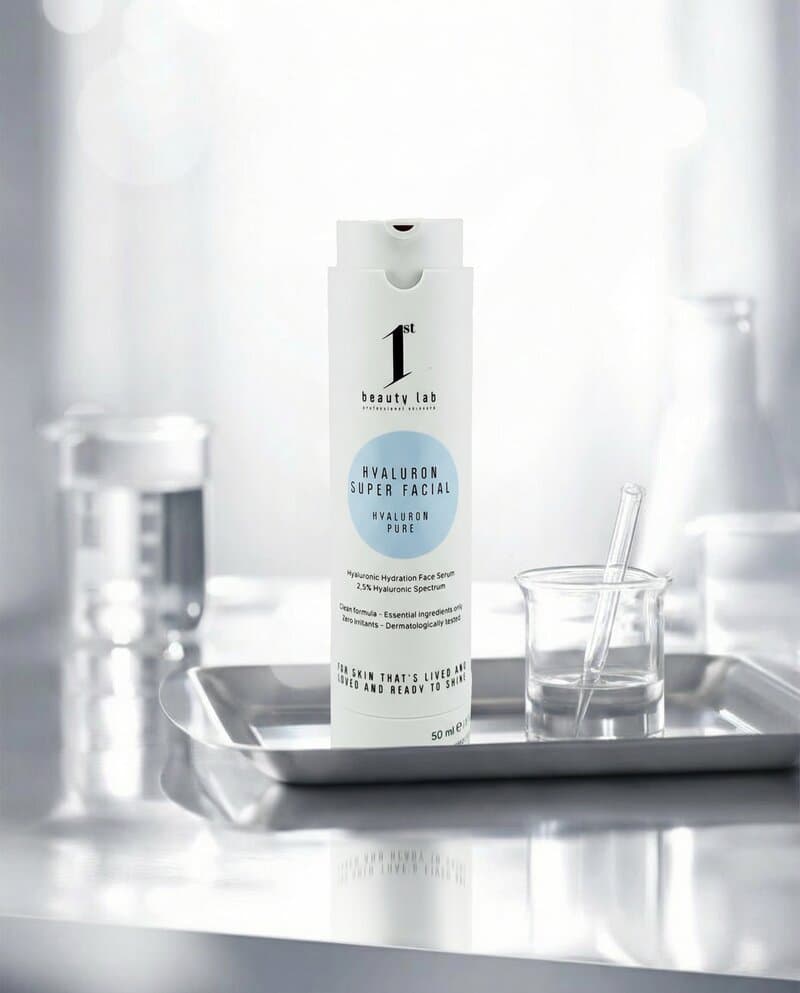
The short answer
A serum is not the sum of its ingredients. It is the result of the decisions made in combining them: in what order are they incorporated? At what temperature? In what ratio?
The same seven ingredients can produce a highly effective serum or a functionless emulsion - depending on how they are brought together. Formulation architecture is the science behind this sequence of decisions. It explains why a short ingredient list is harder to develop than a long one, and why the work of a skilled formulator is invisible on the label.

Claudia Vanicek-Wixinger - Master Cosmetician & Certified Cosmetics Formulator
What Formulation Architecture Means
Knowing the ingredients in a serum does not tell you how it works. It only tells you what is in it.
Formulation architecture describes how those ingredients are brought together. This includes: the order in which components are incorporated, the temperatures at which different stages are mixed, the ratios of ingredients to one another, and the judgement about which substances are compatible - and which interfere with each other's function.
None of these decisions are visible on the packaging. They reveal themselves in the texture of the finished serum, in how it absorbs, in its stability over shelf life, and ultimately in what actually happens on the skin.
Formulation architecture is the part of product development that allows no shortcuts. It requires experience, systematic testing, and the knowledge of which variables actually determine the outcome.
Why Order Determines Effect
Hyaluronic acid is water-soluble. It dissolves readily in the aqueous base of a serum. But it does not dissolve equally well at every temperature, and at too high a concentration without the right supporting ingredient groups, it forms an uneven gel that distributes poorly on the skin.
Tocopherol (Vitamin E) is fat-soluble. In a water-based serum, it requires a specific incorporation temperature and the right carrier to remain homogeneously distributed rather than separating out. Added at the wrong moment in the process, it breaks the emulsion.
Ethylhexylglycerin and Phenoxyethanol - the preservation system - must be incorporated into the finished base after temperature and pH have stabilised. Added too early, they can impair the efficacy of active ingredients. Added too late, they distribute unevenly.
This is not a theoretical concern. It is the reason why professional formulations require batch testing and stability checks over months. A serum that performs well today must still function after twelve months at room temperature.
| Molecular Weight | Where It Works | What It Does |
|---|---|---|
| High | Skin surface | Protective moisture film, immediate smoothing |
| Medium | Upper skin layers | Moisture reservoir, elasticity, firmness |
| Low | Deep epidermis | Long-term hydration, structural renewal |
Ratio: Why Concentration Is Not a Free Variable
Every ingredient has an efficacy window. Below a minimum concentration, it is measurably without effect. Above a maximum, it delivers no additional benefit - or interferes with the function of other ingredients.
Hyaluronic acid at 2.5% is the only concentration figure we disclose publicly - because it is the one variable where the number directly explains what happens on the skin: the point at which the hyaluronic acid does its work with no sticky excess on the skin. Higher concentrations create stickiness without additional depth. Lower concentrations do not reliably reach the absorption threshold.
For every other active, the same principle applies: there is a concentration at which it performs optimally - calibrated against the other ingredients in the formulation, not optimised for a number on the label. These decisions are part of the formulation specification. They remain internal because they are only meaningful in the context of the whole system, not as isolated figures.
What counts is the result on the skin: complete absorption, no layering, no instability. That is the measurable consequence of correct concentration decisions.
Fewer Ingredients Are Harder to Formulate
This is counterintuitive. But it is true.
With twenty or thirty ingredients, a formulator has margin. A weakly active ingredient disappears in the crowd. A slightly unstable combination can be managed with a stabiliser. Texture problems can be masked with thickeners.
With seven ingredients, that margin does not exist. Every ingredient must justify its place. Texture must work without thickeners. The preservation system must be sufficient without impairing the actives. The water base must be of high enough quality to dissolve all actives optimally.
A short INCI list is not a sign of simplicity. It is the result of more development work, not less.
What the Mixing Process Contributes
Two formulations with identical ingredients can perform differently if the mixing process differs. This sounds like alchemy. It is physics.
Hyaluronic acid in three molecular weights must be incorporated into the water base in a specific sequence and at controlled temperatures for each fraction to remain evenly distributed. If the high molecular weight fraction is added too early, it can obstruct the low molecular weight fraction from dissolving properly. If the mixing temperature is too high, low molecular weight chains degrade.
The result of a poorly processed serum with a correct ingredient list: a formulation that works at the surface but delivers no depth. The INCI list is accurate. The effect is not.
At 1st Beauty Lab, mixing temperature, sequence, and incorporation rhythm are part of the formulation specification. They are not variable.
What This Means for Evaluating a Serum
A consumer cannot see the mixing process on a label. What they can observe:
Texture and absorption. A well-formulated serum absorbs completely. No layers, no film, no residue. If a serum sits on the skin or feels sticky, this points to formulation issues - too high a concentration, incorrect molecular weight distribution, or a texture held together by thickeners rather than intrinsic formulation quality.
Stability. Does the serum change in colour, smell, or consistency over weeks? This suggests an insufficient preservation system or an unstable combination of actives.
Transparency. Does the brand explain why each ingredient is present at what concentration? Is there information about the mixing process or the quality of source materials? Formulators who take their work seriously have answers to these questions.
A Note from Claudia
The decision about which molecular weight of hyaluronic acid I begin with when mixing a new serum batch is not arbitrary. It is the result of hundreds of attempts in which I understood what happens when I change the sequence.
Formulation work is not cooking from a recipe. There is no list of steps to follow mechanically. You learn what each variable does by changing it systematically and observing the result on real skin - not in a test tube.
What distinguishes our serums from many others is not visible on the packaging. It is embedded in the decisions made before the serum was filled. And in the knowledge that made those decisions possible.
Claudia Vanicek-Wixinger - Master Cosmetician & Certified Cosmetics Formulator
Frequently Asked Questions
The INCI list shows all ingredients in descending order of concentration. What it does not show: the molecular weight of actives, the precise concentration of individual ingredients (except fragrance allergens above 0.01%), the quality of source materials, and the mixing process. Two serums with identical INCI lists can therefore perform differently.
Phenoxyethanol is a well-tolerated, broad-spectrum preservative that keeps water-based serums safe without refrigeration. The alternative - no preservation system - is not viable for a water-based product: without preservation, microbial contamination is inevitable. We use Phenoxyethanol in combination with Ethylhexylglycerin well below the EU limit of 1%, calibrated for efficacy at minimal risk.
Fragrance has no function for the skin. It increases irritation potential - particularly for sensitive skin, rosacea-prone skin, and skin with a hormonally altered barrier from the fourth decade onward. A serum that smells of nothing is not less premium. It is consistently formulated.
All formulations are developed and produced in Austria. This means: EU manufacturing standards, pharmaceutically purified Austrian spring water, and direct oversight of every production step. No contract manufacturing in third countries.
No. The PIF is the legally required safety documentation for each cosmetic product under EU law. It exists so that the responsible company can prove the product's safety at any time and the authorities can check it. It is kept by the responsible company and made available to the competent authorities on request, but it is confidential. What we disclose publicly: the complete INCI list, the concentration of hyaluronic acid (2.5% targeted Hyaluronic Spectrum), and the results of dermatological testing.
Sources
Cosmetics Europe (2019): "Guidelines on stability testing of cosmetic products." - Industry standard for stability testing and shelf life validation of cosmetic formulations.
EU Cosmetics Regulation No. 1223/2009: Article 11 (Product Information File), Annex V (permitted preservatives and concentration limits). - Legal basis for formulation requirements and preservation systems.
Pavicic T. et al. (2011): "Efficacy of cream-based novel formulations of hyaluronic acid of different molecular weights in anti-wrinkle treatment." Journal of Drugs in Dermatology. - Efficacy evidence for specific concentration and molecular weight combinations.
The complete INCI list for all three serums is on the ingredients page - with an explanation of every single ingredient.