Decision & Routine
How to Choose a Hyaluronic Acid Serum - What Actually Matters
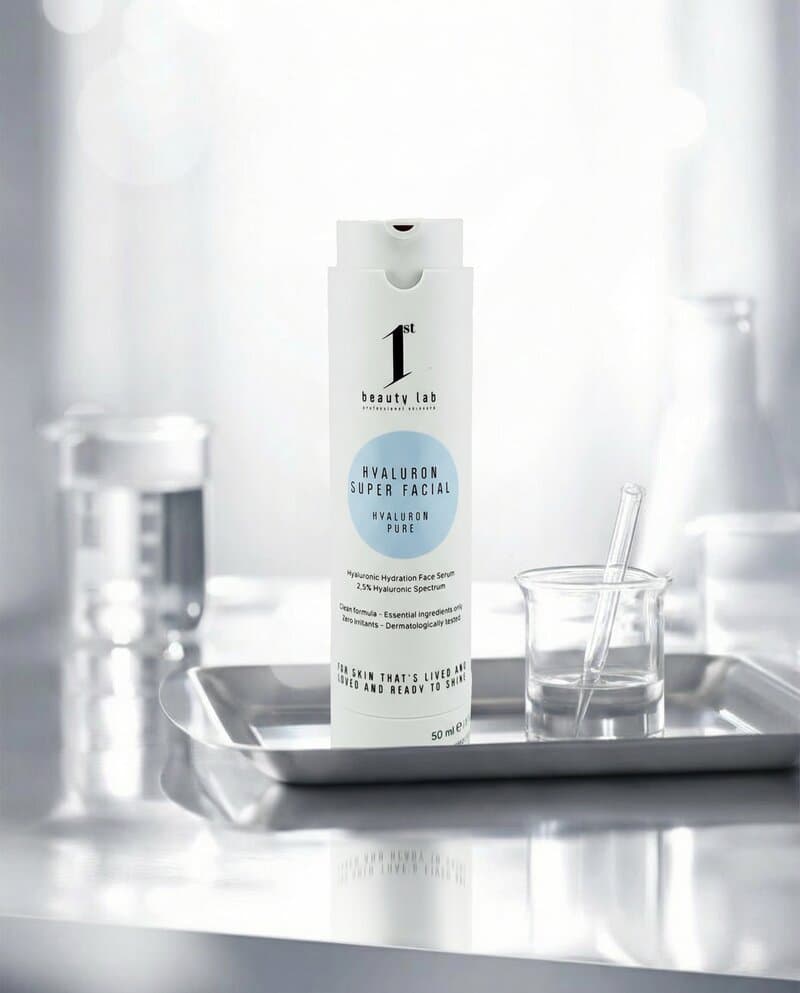
The short answer
A good hyaluronic acid serum tells you what is in it. It states the molecular weight, discloses the concentration, and contains no ingredients without a function. It absorbs completely - no tacky film, no residue.
And it matches your specific skin concern: hydration, firmness, or balance. Price and packaging say nothing about efficacy. The INCI list and the brand's transparency say everything.

Claudia Vanicek-Wixinger - Master Cosmetician & Certified Cosmetics Formulator
The Problem: Too Much Choice, Too Little Information
Hyaluronic acid serums are everywhere. Pharmacies, drugstores, online shops - the range has become impossible to navigate. Prices run from under ten euros to over a hundred. The promises sound broadly the same: hydration, plumping, visibly younger skin.
What most products do not deliver: concrete information about how they intend to achieve any of it. Which molecular weights are present? What concentration? What does each ingredient actually do? Without these specifics, comparing two serums is not possible - regardless of what the front of the packaging says.
This is not an oversight. Less transparency means less accountability. A brand that does not state its concentration cannot be held to it. One that writes "Hyaluronic Acid Complex" without specifying molecular weights sounds scientific without proving anything.
These five criteria let you evaluate any serum on its actual merits.
Criterion 1: Does the Serum State Its Molecular Weight?
Hyaluronic acid is not one thing. The same substance in different molecular sizes acts in entirely different skin layers. High molecular weight HA stays at the surface. Low molecular weight HA penetrates deeply. A serum that only hydrates superficially will not deliver structural depth.
What to check: Does the brand state how many molecular weights are present? Are the weight categories communicated - high, medium, low - or specific kDa ranges?
What it means: If the product page only lists "Hyaluronic Acid" or "Sodium Hyaluronate" with no further specification, you have no way of knowing which skin layer the serum is actually reaching. That is not a technical detail. It is the central piece of information that determines whether the product does what you want it to do.
Formulations worth trusting name their molecular weights. When this information is absent, it is not absent by accident.
| Molecular Weight | Where It Works | What It Does |
|---|---|---|
| High | Skin surface | Protective moisture film, immediate smoothing |
| Medium | Upper skin layers | Moisture reservoir, elasticity, firmness |
| Low | Deep epidermis | Long-term hydration, structural renewal |
Criterion 2: Is the Concentration Disclosed?
The second piece of information most brands do not communicate: how much hyaluronic acid is actually in the serum.
High percentages in advertising are not a reliable indicator. A formulation with 5% high molecular weight HA delivers less depth than one with 2.5% split across three molecular weights. What counts is not the total figure but how much of which size reaches the skin and can actually be used.
There is also a practical threshold: above a certain concentration, the skin cannot absorb the molecules fast enough. They accumulate on the stratum corneum, create a sticky feeling, and deliver no additional benefit. Stickiness is not a sign of potency. It is the opposite.
What to check: Does the brand state the total concentration of hyaluronic acid? Does it explain how that concentration is distributed across molecular weights?
Criterion 3: How Short Is the INCI List?
The INCI list is the only document legally required to be complete and accurate. Everything else on the packaging is marketing.
A short INCI list - seven to twelve ingredients - is not a sign of cutting corners. It is a sign of formulation discipline. Every ingredient has a function. No fillers inflating volume without contributing. No fragrance making the serum smell pleasant at the cost of increased irritation potential. No synthetic film-formers simulating a silky skin feel without actually hydrating.
With a long INCI list, a weak active can disappear in the crowd. With seven ingredients, there is nowhere to hide. Every entry carries weight.
What to check: Is every ingredient on the list explainable? Does the brand explain why each ingredient is present? Does the list include fragrance (Parfum), denatured alcohol (Alcohol denat.), or silicones (Dimethicone)?
A serum for daily use on sensitive or ageing skin should avoid fragrance and denatured alcohol. Both measurably increase irritation potential - and if a serum is not tolerated well, these are the most likely culprits.
Criterion 4: Does the Serum Match Your Specific Concern?
Hyaluronic acid is a base active. It hydrates. That is its core function, and it delivers it reliably. But a serum can go further than basic moisture delivery - if the formulation is built around a specific concern.
If the primary concern is hydration and skin feel: A pure hyaluronic acid serum with multiple molecular weights and a clean base formulation is sufficient. No additional actives needed, no unnecessary complexity.
If the primary concern is firmness and wrinkle reduction: A formulation combining hyaluronic acid with collagen peptides addresses not just hydration but also the structural protein that declines with age. Marine collagen peptides show measurable improvements in elasticity and fine line depth in clinical studies.
If the primary concern is a more even, radiant complexion: A formulation pairing hyaluronic acid with niacinamide regulates sebum production, refines pores and skin tone, and strengthens the skin barrier simultaneously.
The question is not which serum is "the best." The question is which serum fits what your skin needs right now.
Criterion 5: Is the Packaging Appropriate for the Formula?
Hyaluronic acid is light-sensitive. Heat and oxygen exposure accelerate molecular breakdown - particularly the low molecular weight fraction, which is the most difficult to stabilise.
A glass bottle with a dropper is elegant. It is not a good container for a serum intended to deliver depth: every time it is opened, air enters; oxygen exposure accumulates over weeks; light transmission accelerates degradation.
The appropriate packaging for a hyaluronic acid serum is an airtight, light-protected dispenser - ideally airless. An airless pump keeps oxygen contact to a minimum. UV protection in the container wall shields against light degradation. Precise dosing prevents over-application.
What to check: Is the serum in an airless system? Is UV protection built into the container? If not - what does the brand do to ensure formula stability over the product's lifespan?
Summary
Five criteria. One serum that meets all five is one that takes its active ingredient seriously.
Molecular weight - Weight categories or kDa ranges stated. Concentration - Total HA concentration transparently disclosed. INCI list - Short, explainable, no fragrance or alcohol. Skin concern - Formulation matches your specific need. Packaging - Airless, UV-protected, precise dosing.
No single criterion is decisive on its own.
A Note from Claudia
In thirty years as a cosmetician I have seen many products that sounded convincing on the packaging and did nothing on the skin. And the reverse: unassuming formulations with short ingredient lists that produced visible change after four weeks.
What I have learned: anyone who wants to genuinely evaluate a serum turns the bottle over and reads. Not the front. The back. The INCI list. When a brand explains its ingredients and names its concentrations, it has nothing to conceal. When it does not, the question of why is fair.
I formulated the serums in this line so that every question can be answered. That is the standard I hold every product to that I recommend to my clients in my treatment room in Vienna.
Claudia Vanicek-Wixinger - Master Cosmetician & Certified Cosmetics Formulator
Frequently Asked Questions
Not necessarily. Price does not reliably correlate with efficacy in skincare. What determines results is formulation, molecular weight, and concentration - not the number on the label. A well-formulated mid-range serum frequently outperforms a poorly formulated luxury product.
Generally not worth it. If both serums contain hyaluronic acid, the molecules compete for the same binding sites in the skin. More effective is a single serum combining multiple molecular weights in one calibrated formulation - rather than layering two separate products.
In very dry conditions or on very dry skin, a follow-up moisturiser that seals in the moisture is beneficial. Hyaluronic acid binds water - but in very dry air, it can also draw moisture from deeper skin layers if there is nothing to seal the surface. A light day cream after the serum prevents this.
Surface results are immediate: smoother, fresher-looking skin after the first application. Structural results - firmness, wrinkle depth reduction - require four to six weeks of consistent daily use. Evaluating after one week captures surface effect only.
Yes. Hyaluronic acid is a substance the body produces naturally - irritation potential is minimal. The irritation risk in most serums comes from other ingredients: fragrance, certain preservatives, or denatured alcohol. For sensitive skin: read the INCI list, choose formulations without parfum and Alcohol denat., and patch-test on first use.
Sources
Essendoubi M. et al. (2016): "Human skin penetration of hyaluronic acid of different molecular weights as probed by Raman spectroscopy." Skin Research and Technology. - Basis for Criterion 1: penetration depth by molecular weight.
Pavicic T. et al. (2011): "Efficacy of cream-based novel formulations of hyaluronic acid of different molecular weights in anti-wrinkle treatment." Journal of Drugs in Dermatology. - Efficacy evidence for specific molecular weight selection.
Gehring W. (2004): "Nicotinic acid/niacinamide and the skin." Journal of Cosmetic Dermatology. - Niacinamide efficacy in combination with hydration routine.
The skin assessment identifies which of the three serums fits your concern - 25 questions in about three minutes, no email address required.