Ingredient Science
Molecular Weight in Hyaluronic Acid: Why Three Weights Do What One Cannot
The short answer
The molecular weight of hyaluronic acid determines how deeply it penetrates the skin. Measured in kilodaltons (kDa): the smaller the molecule, the deeper the penetration. High molecular weight hyaluronic acid (above 1,000 kDa) stays on the skin surface, forming a moisture film.
Low molecular weight hyaluronic acid (below 300 kDa) passes through the stratum corneum and reaches deeper layers, where it acts structurally. A serum containing only one molecular weight works on only one level. Three specific weights in a calibrated formulation reach the surface, the middle layers, and the depth simultaneously. That is the difference between a serum that feels good and one that works in depth, not just on the surface.

Claudia Vanicek-Wixinger - Master Cosmetician & Certified Cosmetics Formulator
What Molecular Weight Actually Means - Without a Chemistry Degree
Molecular weight sounds like lab coats and equations. The principle behind it is straightforward.
Every substance is made up of molecules. These molecules have a size. With hyaluronic acid, that size is measured in kilodaltons (kDa). One kilodalton is an extremely small unit - the numbers sound large, but we are talking about structures invisible to the naked eye.
What size means in practice: skin has an outer layer called the stratum corneum. It functions as a selective barrier. Smaller molecules can pass through it. Larger molecules cannot. The molecular weight of a hyaluronic acid molecule therefore directly determines whether - and how far - it can penetrate the skin.
A hyaluronic acid molecule at 50 kDa behaves fundamentally differently in the skin from one at 1,500 kDa. Both are chemically hyaluronic acid. But their depth of action and mechanism of effect are different.
What the Research Specifically Shows
This is not a marketing argument. It is measured.
Scientists have used Raman spectroscopy - a method that can localise molecules inside skin tissue without damaging it - to map exactly where hyaluronic acid of different molecular weights ends up after application.
The finding (Essendoubi et al., 2016): low molecular weight hyaluronic acid between 20 and 300 kDa passes through the stratum corneum and reaches the layers beneath. High molecular weight hyaluronic acid between 1,000 and 1,400 kDa remains at the surface. It does not penetrate.
A subsequent study tested twelve different hyaluronic acid variants with varying molecular weights directly on skin tissue (Giardina & Poggi, 2023). Result: penetration rate was inversely proportional to molecular weight. Low molecular weight HA below 100 kDa reached the dermis with an absorption rate of 14 to 19 percent. Higher molecular weight variants ranged between 2.7 and 10 percent.
This does not mean high molecular weight hyaluronic acid is without value. It means it serves a different function. And it means a serum containing only one molecular weight inevitably leaves part of the skin unaddressed.
| Molecular Weight | Where It Works | What It Does |
|---|---|---|
| High | Skin surface | Protective moisture film, immediate smoothing |
| Medium | Upper skin layers | Moisture reservoir, elasticity, firmness |
| Low | Deep epidermis | Long-term hydration, structural renewal |
What Each of the Three Weights Specifically Does
Three weights. Three precise jobs.
High molecular weight - the surface
Remains on the stratum corneum. Lays down a flexible, moisture-binding film across the skin. This film prevents transepidermal water loss - the evaporation of moisture that is a persistent problem in heated interiors, wind, and dry climates.
Effect: immediate visible smoothing. The complexion looks fresher. The feeling lasts for several hours. This effect is real, but it operates at the surface. It says nothing about what is happening in the layers beneath.
Medium molecular weight - the middle layer
Penetrates the upper living layers of the epidermis. There it binds water in the tissue and builds a moisture reservoir the skin can draw from over hours. It supports elasticity and contributes to firmness.
Effect: keeps the skin hydrated for longer, even without reapplication. Improvement in firmness and bounce develops over weeks of consistent use.
Low molecular weight - the depth
Passes through the stratum corneum and reaches the deeper epidermis. Studies on low molecular weight hyaluronic acid describe a stimulation of keratinocyte renewal there - the turnover of the skin cells from which the outer layer is built. With age, this renewal slows, the skin thins, and it loses structural integrity.
Effect: structural, not immediately visible. The skin behaves differently after four weeks than it did before. Complexion becomes more even. This is the effect that stays.
Why Claudia Settled on Three Weights After Five Years
During the development of the Hyaluron Super Facial serums, Claudia tested formulations combining up to 14 different molecular weights in a single serum. Five years of development. The result was counterintuitive.
More weights did not produce better results. They produced more diffuse results. When too many molecular sizes compete in a single formulation, each one gets a smaller share of the total concentration - and with it, less depth of effect. The formulation becomes more complex. It does not become more effective.
Three specific weights, each targeting a defined skin depth, delivered the strongest and most consistent results across every test round. Not two, because the middle layer would be left unaddressed. Not four or more, because the additional weights reach no new depth - they compete with the existing ones.
This is formulation discipline. Not more than is needed. But precisely what is sufficient.
Why Some Serums Feel Sticky - and What That Actually Means
The sticky feeling that many hyaluronic acid serums leave behind is not accidental and not a quality marker. It is a sign that the formulation contains more than the skin can absorb.
High molecular weight hyaluronic acid that cannot penetrate deeper layers stays on the surface. When concentration exceeds the skin's absorption threshold, molecules pile up on the stratum corneum. They bind moisture, but they cannot sink in. The result is a sticky, sometimes slightly white residue.
This effect is amplified when the serum is applied to dry skin: the hyaluronic acid then draws moisture upward from deeper layers rather than delivering it from outside. The opposite of the intended effect.
A well-formulated serum absorbs completely. No residue. No tacky film. After absorption, skin feels like skin.
What the INCI List Shows - and What It Doesn't
On a serum's INCI list, the active ingredient appears as "Sodium Hyaluronate" - the sodium salt form of hyaluronic acid. What does not appear: the molecular weight.
This means a consumer reading "Sodium Hyaluronate" on an ingredient list has no way of knowing which molecular weight they are dealing with. Most brands do not communicate this information - not on the packaging, not on the product page.
What you can look for instead: Does the brand state the molecular weight or molecular weight categories? Is the total concentration of hyaluronic acid disclosed? Does the brand explain how many molecular weights are present and why?
If none of these questions are answered, the formulation is a black box. That is not necessarily a statement about quality - but it is a statement about what the brand considers worth communicating.
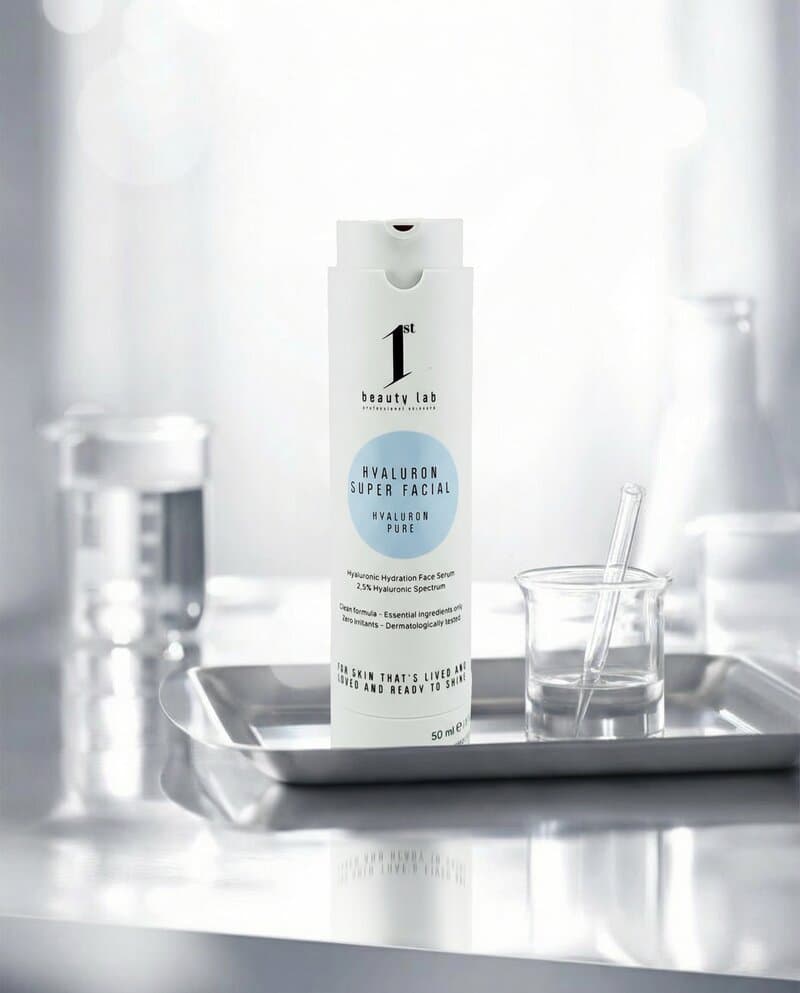
At 1st Beauty Lab: three molecular weights, 2.5% total concentration, complete INCI list on every bottle. No proprietary blend language. No gaps.
A Note from Claudia
The question I ask myself with every formulation decision is the same: what actually happens to this molecule when it meets the skin? Not what theory predicts. What I observe in practice.
Molecular weight was for a long time a conversation that happened only within formulation chemistry. It fascinated me because it is one of the few variables where the effect is directly measurable rather than simply felt. I spent years experimenting with different weights until I found the combination that proved itself not just on paper, but in professional treatments in my treatment room in Vienna.
The decision to use three weights was not the simplest one. It was the one that held up over time.
Claudia Vanicek-Wixinger - Master Cosmetician & Certified Cosmetics Formulator
Frequently Asked Questions
kDa stands for kilodalton, a unit of molecular mass. For hyaluronic acid, the kDa value indicates how large the molecule is. Lower values mean smaller molecules capable of penetrating deeper into the skin. Higher values indicate molecules that remain on the surface and act as a moisture film.
Low molecular weight hyaluronic acid below 300 kDa. Studies using Raman spectroscopy show that HA in this size range passes through the stratum corneum and reaches the layers beneath. HA below 100 kDa shows the highest penetration rates into both the epidermis and dermis.
No. It has a different function. High molecular weight HA forms a protective film on the skin surface, binds moisture, and prevents water evaporation. This surface action is valuable - particularly in dry environments. A formulation containing only low molecular weight HA would not provide this surface protection.
After five years of development and testing with up to 14 molecular weights in a single formulation, the finding was clear: three specific weights, each targeting a defined skin depth, deliver more consistent and stronger results than more complex combinations. Additional weights do not increase depth of action - they distribute the available concentration across more targets without adding benefit.
INCI nomenclature does not require disclosure of molecular weight. The entry "Sodium Hyaluronate" identifies the substance, not its molecular size. Brands are not obligated to communicate this. Some do voluntarily. Most do not.
Sources
Essendoubi M., Gobinet C., Reynaud R., Angiboust J.F., Manfait M., Piot O. (2016): "Human skin penetration of hyaluronic acid of different molecular weights as probed by Raman spectroscopy." Skin Research and Technology, Wiley. - Raman spectroscopy study: HA below 300 kDa passes stratum corneum; HA above 1,000 kDa remains at surface.
Giardina S., Poggi A. (2023): "Skin Penetration Ability of 12 Hyaluronic Acids with Different Molecular Weights After Topical Application." JOJ Dermatology & Cosmetics. - Twelve HA variants tested: penetration rate inversely proportional to molecular weight. HA below 100 kDa: 14-19% absorption rate in epidermis and dermis.
Pavicic T. et al. (2011): "Efficacy of cream-based novel formulations of hyaluronic acid of different molecular weights in anti-wrinkle treatment." Journal of Drugs in Dermatology. - 76 subjects, 60 days: 50 kDa HA reduced wrinkle depth significantly with excellent tolerability.
Farwick M. et al. (2011): "Fifty-kDa hyaluronic acid upregulates some epidermal genes without changing TNF-alpha expression." Skin Pharmacology and Physiology. - Structural effect on keratinocyte renewal without inflammatory response.
All three Hyaluron Super Facial serums contain 2.5% targeted Hyaluronic Spectrum across three specific molecular weights. The complete INCI list is available on every bottle and on the product page. The skin assessment helps identify which one is right for your skin.