Ingredient Science
Hyaluronic Acid in Serums: What It Actually Does and Why Molecular Weight Is Everything
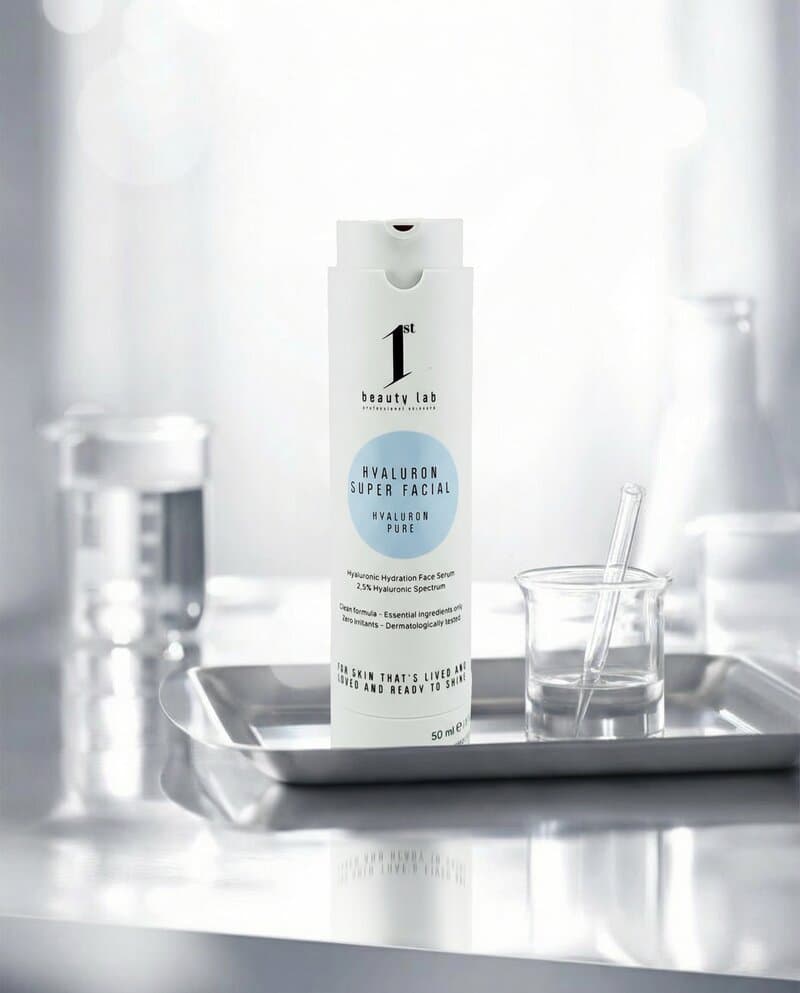
The short answer
Hyaluronic acid is a substance your body produces naturally. It holds water in the skin and keeps it hydrated from within. Its levels decline significantly with age. In a serum, it can replenish this loss - but only if the molecular weight is right. High molecular weight hyaluronic acid stays on the skin surface, forming a protective moisture film.
Low molecular weight hyaluronic acid penetrates into deeper layers and works there structurally. A serum combining both sizes works simultaneously at the surface and in depth. Concentration should be high enough to make a measurable difference, but not so high that excess molecules sit on the skin unable to absorb - creating stickiness without benefit.

Claudia Vanicek-Wixinger - Master Cosmetician & Certified Cosmetics Formulator
What Hyaluronic Acid Is and Why Skin Needs It
Hyaluronic acid is not a foreign substance. The body produces it naturally - primarily in the skin, joints, and connective tissue. Its defining property: it can bind and hold many times its own weight in water.
In younger skin, high levels of naturally produced hyaluronic acid keep the skin plump, elastic, and well hydrated. From the third decade onward, these levels begin to decline. The skin gradually loses its ability to retain moisture. This shows as finer lines, a duller complexion, and a dryness that returns quickly even after moisturiser.
A well-formulated hyaluronic acid serum can replenish this loss from the outside. The decisive factor is not simply the amount of hyaluronic acid a serum contains - it is the size of its molecules.
Why Molecular Weight Is the Factor That Actually Determines Results
Hyaluronic acid is not one thing. The same substance can exist in very different molecular sizes, measured in kilodaltons (kDa). This size determines how deeply a molecule can penetrate the skin and what it does once it gets there.
High molecular weight hyaluronic acid (above 1,000 kDa) is too large to pass through the outermost skin layer. It stays on the surface, laying down a thin, flexible film that binds moisture and prevents water loss. This is not without value - the film delivers an immediate smoothing and firming effect that lasts for hours. But its action stays at the surface.
Low molecular weight hyaluronic acid (below 300 kDa) is small enough to pass through the stratum corneum. It reaches the deeper skin layers, hydrates the connective tissue, and acts on the structural proteins responsible for firmness and elasticity. Its effect is less immediately perceptible, but more durable.
Studies using Raman spectroscopy - which map exactly where hyaluronic acid ends up inside the skin - confirm this distinction clearly: low molecular weight HA below 300 kDa passes through the stratum corneum; high molecular weight HA above 1,000 kDa remains at the surface (Essendoubi et al., 2016).
A serum using only one molecular weight works on only one level. It delivers either immediate surface action or deeper structural benefit - not both at once. Delivering both simultaneously requires a serum that combines multiple molecular weights in a calibrated formulation.
| Molecular Weight | Where It Works | What It Does |
|---|---|---|
| High | Skin surface | Protective moisture film, immediate smoothing |
| Medium | Upper skin layers | Moisture reservoir, elasticity, firmness |
| Low | Deep epidermis | Long-term hydration, structural renewal |
Why Concentration Matters - and Where Its Limits Are
In skincare marketing, higher concentrations are often presented as a sign of quality. More percentage sounds like more efficacy. With hyaluronic acid, this is worth examining more carefully.
The skin has a capacity. It can only absorb hyaluronic acid as fast as its structure allows. Beyond a certain threshold, excess molecules cannot penetrate further. They remain on the surface and create a sticky, tacky feel - without any additional benefit.
This is why many high-concentration hyaluronic acid serums leave the skin feeling sticky. Not because they are particularly potent, but because the formulation contains more than the skin can absorb.
The optimal concentration is the point of full benefit with no sticky excess on the skin. At 1st Beauty Lab, this was determined after five years of development in professional treatments in Claudia's practice: 2.5%. Not a marketing number. The point beyond which further increases produce no measurable improvement in skin response.
What Happens When You Apply the Serum
The effect of hyaluronic acid in a serum unfolds in three overlapping phases:
Immediately - within the first minutes High molecular weight hyaluronic acid settles on the skin surface. The skin feels smoother right away. Fine dehydration lines are visually softened. The complexion looks fresher. This effect persists as long as the serum remains on the skin.
Within a few hours Medium molecular weight hyaluronic acid penetrates the upper skin layers and begins binding and storing moisture there. The skin stays hydrated for longer, even without reapplication. This phase builds the foundation for sustained results.
Over weeks of consistent use Low molecular weight hyaluronic acid reaches the deeper layers. Studies on low molecular weight hyaluronic acid describe a stimulation of keratinocyte renewal, the turnover of the cells from which the outer skin layer is built. This phase is not visible overnight. It builds with consistent daily use.
This is why we ask for 30 days before drawing conclusions. The surface benefits are immediate. The structural benefits take time. And they compound.
What Most Serums on the Market Do Differently
Most hyaluronic acid serums use one or two generic molecular weights, selected for manufacturing availability and cost rather than skin performance. Concentrations are rarely disclosed. When they are, the number is often chosen for label appeal - higher sounds better - rather than for what absorption science actually supports.
Ultra-luxury brands rarely specify molecular weight at all. The term "hyaluronic acid" appears on the INCI list, but without knowing the molecular weight, there is no way to determine which skin layer the ingredient is actually reaching.
At 1st Beauty Lab, we disclose everything: three molecular weights, 2.5% total concentration, the complete INCI list on every bottle. If you want to compare our formulation to any other serum on the market, you have everything you need to do so.
A Note from Claudia
I spent five years developing and refining the molecular weights in professional treatments in my treatment room in Vienna, not in a lab simulation.
The finding was unambiguous. More weights do not mean better hydration. They mean unfocused hydration. Three specific weights, working at three specific depths, consistently outperformed every other combination I tested.
The difference I see in clients is not the feeling immediately after application. Any decent serum can deliver that. The difference is how the skin behaves after four weeks. Whether it starts to hold moisture on its own. Whether the fine line above the lip is a little shallower. Whether the complexion is visibly more even. That is the depth effect.
Claudia Vanicek-Wixinger - Master Cosmetician & Certified Cosmetics Formulator
Frequently Asked Questions
Once every morning is the base routine, applied to cleansed skin before moisturiser or day cream. For more intensive care, also apply it in the evening. Hyaluronic acid develops its full effect with consistent daily use. Occasional application does not deliver lasting results.
In rare circumstances - specifically when applied in very dry air without a follow-up moisturiser - high molecular weight HA can draw moisture from deeper skin layers to the surface. This is easily avoided by applying the serum to slightly damp skin and following with a cream.
Three molecular weights of Sodium Hyaluronate, selected specifically so each reaches a distinct skin depth. Not a marketing term - a description of the formulation architecture. Surface, upper layers, and deep epidermis are supplied simultaneously.
Because the concentration exceeds the skin's absorption threshold. The excess molecules cannot penetrate further and remain on the surface. This is not a sign of potency - it is a sign of over-formulation. A well-calibrated serum absorbs completely and leaves no sticky residue.
Sodium hyaluronate is the sodium salt form of hyaluronic acid. It is more stable in formulation and has slightly better penetration due to its marginally smaller molecular structure. In practice the terms are often used interchangeably. On an INCI list, the ingredient appears as "Sodium Hyaluronate."
Sources
Essendoubi M., Gobinet C., Reynaud R., Angiboust J.F., Manfait M., Piot O. (2016): "Human skin penetration of hyaluronic acid of different molecular weights as probed by Raman spectroscopy." Skin Research and Technology, Wiley. - Confirms differential penetration by molecular weight in human skin.
Pavicic T. et al. (2011): "Efficacy of cream-based novel formulations of hyaluronic acid of different molecular weights in anti-wrinkle treatment." Journal of Drugs in Dermatology. - 76-subject study: 50 kDa HA showed significant wrinkle depth reduction after 60 days, with excellent tolerability and no pro-inflammatory response.
Giardina S., Poggi A. (2023): "Skin Penetration Ability of 12 Hyaluronic Acids with Different Molecular Weights After Topical Application." JOJ Dermatology & Cosmetics. - Penetration rates across 12 HA variants: low molecular weight HA below 100 kDa reached the dermis with 14-19% absorption rate.
Farwick M. et al. (2011): "Fifty-kDa hyaluronic acid upregulates some epidermal genes without changing TNF-alpha expression." Skin Pharmacology and Physiology. - Structural effect of low molecular weight HA on keratinocyte renewal without inflammatory response.
All three serums in the Hyaluron Super Facial line contain 2.5% targeted Hyaluronic Spectrum across three specific molecular weights. The skin assessment helps identify which one is right for your skin.